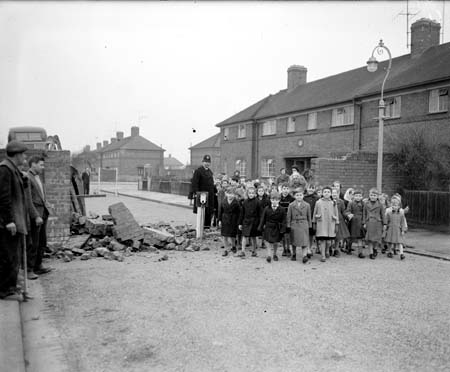
The case was heard in the Chancery Division of the High Court before Mr Justice Bennett. It started on 20th July 1939 and judgement was given four days later. Mr Erskine Sims and Mr C E Scholefield represented the Company and Sir Stafford Cripps, KC and Mr Wilfred Hunt represented the Corporation.
The arguments centred on the conveyance which regulated the sale of the land to the Urban Housing Company, on the Private Street Works Act, 1892, and on the Public Health Act, 1875.
Sir Stafford Cripps submitted that there was a clear covenant in the conveyance that the roads were to remain open at both ends and that there was also a prohibition against building walls across the roads. An important part of the argument turned on clauses 5 and 7 which were designed to limit the way the Company could develop its land. Clause 5 commenced, 'The Purchasers shall only erect on the land...' and then went on to list various items which obviously did not include walls across the road.
The relevant part of clause 7 stated, '...no building or erection of any kind except a fence or other enclosure and a gate or gates shall be erected on any part of the said piece or plot of land which lies between the said building lines and the road or on the sites of the proposed roads marked on said estate plan'.
These clauses were sufficient to prevent the Company from putting up the walls according to Sir Stafford. The only erection it could put on its rpoads was a fence or a gate but this permission was itself limited to the 'site of the proposed roads.' The point of this, he claimed, was to allow the Company to fence its land while building was in progress and as soon as the roads were completed this permission had come to an end.
He also contended that Clause 8 was sufficient to prevent the Company from maintaining the walls. This clause forbade the Company to put up any 'house or other buildings' other than those on the estate plan , until the plans had been approved by the Corporation. Sir Stafford argued that 'other buildings' was to be interpreted in the widest possible sense to mean anything of which a plan showing elevation, sections and specifications could be submitted and in this sense would clearly include walls.
He also noted that Carlton and Wentworth Roads were referred to in the conveyance as 'continuation streets' whereas all the others were referred to simply as 'streets'. This showed that Carlton and Wentworth Roads were meant to continue into the Cutteslowe Estate. He drew attention to the conveyance which showed the two roads running without obstruction straight into the Cutteslowe Estate and said that the Company was obliged to follow this plan.
Clause 4 required the Company to construct the streets 'in a manner and to the satisfaction in all respects of the Vendors as the Local Authority'. Since the blocked streets were manifestly not to the satisfaction of the Corporation, this clause also prevented the Company from building the walls.
Sir Stafford also contended that a covenant to construct through roads was sufficient to prevent the blocking of the roads even after construction had been completed. The Corporation had not introduced a special covenant requiring the Company to maintain as well as to construct through roads because this was unnecessary. Furthermore, clause 4 had to be read together with clause 18 in which the phrase 'scheme of roads' was used. The scheme of roads covered both estates, its most important feature was the two through roads, and clause 18 made it binding on the Company. According to this argument the Company was bound by clause 4 to construct, and by clause 18 to maintain, Carlton and Wentworth Roads as through roads.
According to Mr Erskine Simes for the Urban Housing Company, the conveyance had been drafted so as to allow the Company to cut off its land from the Cutteslowe Estate if it wanted to do so. This was because the Corporation could not give lawful guarantees about how the Cutteslowe Estate would be developed. Consequently the Company had retained in the conveyance the right to cut off its land if the development on the neighbouring estate was not to its liking. In support of this argument he pointed out that there was a well-known covenant to keep roads open and not built upon which the Corporation could have used but did not. He also noted that no right of way had been granted over the Company's roads although the Company itself had been granted a right of way over the parts of Carlton and Wentworth Roads which lay to the west and which had been retained by the Corporation. If the Corporation had intended to insist on Carlton and Wentworth Roads running into the Cutteslowe Estate then surely it should have made provision for a right of way.
Regarding clause 7, which forbade the Company to erect anything other than fences or gates on the 'sites of the proposed roads' Erskine Sims argued that walls could properly be considered fences. He quoted the Oxford Dictionary's definition of fence; 'An enclosure or barrier, for example, a hedge, wall...' The phrase 'sites of the proposed roads' did not mean, as Sir Stafford Cripps had argued, that permission for fences continued only so long as the roads were under construction. The word 'proposed' had been used because when the original contract was made the roads to be marked on the estate plan had not been finally fixed because they had not yet received the approval of the City Council. 'Proposed' in this interpretation meant simply the roads it was proposed to show on the final plan and, therefore, the power to put fences across the roads was not limited to the period before the roads were completed but continued indefinitely
He also gave a different interpretation of the phrase 'continuation streets' in clause 4. The continuation referred to was not from the Urban Housing Estate into the Cutteslowe Estate but from the parts of Carlton and Wentworth Roads owned by the Corporation into the parts of the same roads owned by the Company.This Act was designed to deal with the problem of private streets which, in the opinion of the local authority concerned, were inadequately made up or lit. Having adopted this Act, the Corporation had power under section 19 to declare certain private streets to be 'highways repairable by the public at large'. The Corporation was fully within its rights in adoptin gthe Act and proceeding as it did under Section 19 and it was clear that the streets on the Urban Housing Estate had now passed to the Corporation under the Private Street Works Act but the crucial question concerned the strips of land, nine inches wide on which the walls had rested.
Sir Stafford Cripps attempted to establish that the road works had all been fully completed at the sites of the walls and that the walls, therefore, had been built on top of the roads or that some part of the roads had been removed when the walls were put up. He argued tha tthe sites of the walls must have been covered by the declaration of Jume 8th when the walls were down and their sites were, in fact, part of the roads. This resolution must have been effective he said,
Mr Erskine Simes argued that the sites were not part of the streets and that the Council's resolution of May 16th, while effective for the streets, was not effective for the strips on which the walls actually rested. The Council had used the word 'junction' in its resolution in order to include these strips of land. Erskine Simes contended that 'junction' was an incorrect description and that the Corporation could not make a junction where none existed. He also maintained that even if the sites of the walls were part of the streets then the Corporation hasd to take over the streets as it found them, subject to any obstructions. It could not clear the obstructions away unless it obtained the consent of the owner,
Regarding the declaration made on June 8th after the walls had been demolished, Erskine Sms declared that theif the Corporation was wrong in demolishing the walls it could not make the sites of the walls part of the highway by making this declaration subsequent to the demolition. Mr Justice Bennett immediately supported this point.
With regard to the completion of the roads, Erskine SIms did not accept that they had been completed and also cited cases to show owners of private streets could take out part of their streets and that,
Section 26 of this Act gave a local authority power to remove or alter buildings which had been erected without the authority's permission over sewers. The relevant part read: ' the urban authority may cause any building...constructed in contravention of this section to be altered, pulled down or otherwise dealt with as they think fit...'
There was no doubt that the Cutteslowe walls were over sewers and there was no doubt that they had been placed there without the Corporation's consent. The only question was whether they were buildings within the meaning of the Act.
At one point the Judge and both parties agreed that a building for the purpose of theis Section was any structure which because of its size or weight might damage the sewer or make access to it difficult. Sir Stafford Cripps argued that the walls met both criteria but Mr Justice Bennett was doubtful and noted that Sir Stafford had called no evidence. Sir Stafford then argued that it was necessary to take into consideration the general evil aimed at in the Act and not the particular circumstances of the case. He said that
In reply Erskine Simes stated , 'My primary argument...is that this wall was not a building to which the section applied...om the evidence which your Lordship hasm your Lordship cannot say that this wall was a building of such a nature either as to injure the sewer or to render access to it difficult.
Sir Stafford had argued that it was entirely up to the local authority to decide whether a particular building was a danger to a sewer and under section 26 of the Public Health Act, 1875 there was no provision for any appeal. However, this secton of the Act was replaced by Section 25 of the Public Health Act of 1936 which did make provision for an appeal and which came into effect on 1st October 1937.
The Corporation had ordered the removal of the walls on 20th September 1837 and seemed to have given an order from which there was no right of appeal but Erskine Simes argued that this was not a proper notice because it only ordered the Company to remove the walls and made no provision for the COmpany to 'show cause' why the walls ought not to be demolished. The Corporation could not demolish the walls, he maintained, without giving the Company this opportunity. As the new Act had now passed into law, the Corporation could now only serve a new notice on the Company subject to the Company's right to appeal.
Mr Justice Bennett pressed Erskine Simes on this point and asked what redress the Company would have if an opportunity to 'show cause' had been given and if , after listening to the COmpany's case, the Corporation had still proceeded to demolish the walls. Erskine SImes contended that the Company could have then come to court with an action for trespass which would have forced the court to determine whether or not the walls were buildings within the Act. Thus, even under the Act of 1875, the Corporation was not entitled to avoid a decision in the courts by just pulling the walls down
Mr Justice Bennet started by drawing attention to three matters of fact:
FIrst, there had always been a break in the surface of Carlton and Wentworth Roads at their respective junctions with Wolsey and Aldrich Roads although he considered this fact to be of no importance.
Second, he noted that no evidence had been called to suggest that the wall smight damage the sewers or make access to them difficult.
Thirdly, he stated that the cost of re-erecting the walls would be £180.
Turning to the conveyance, he drew attention to three points.
First, a right of way had been granted to the Company over the Corporation's part of Carlton and Wentworth Roads.
Second. no rights of waty were granted to the COrporation ove rthe COmpany's part of Carlton and Wentworth Roads.
Thirdly, provision had been made to prevent the Company's gainin gany easement of light over the adjacent land which had been retained by the Corporation.
The Corporation's first ground was that it ought oto be held as a matter of implication that the two roads were to be through roads. But this was unsound as, if the Corporation wanted through roads, they should have been stipulated as such in the conveyance.
The second ground was that the COmpany had covenanted not to build across the roads. This depended on interpretation of clauses 5, 7 and 9. He djudged thatthe real object of clause 5 was to limit the density of housing on the estate and that it was not relevant to the issue of the walls. Clause 7 gave permission to erect fences and the question was whether this could be taken to include a brick wall. He judged that it could. Clause 9 forbade tthe erection of buildings other than thoise specified and if the walls were 'buildings' then they were clearly forbidden by this clause. However, since he had already judged walls to be 'fences' for clause 7 they could not be 'buildings' in clause 9.
With regard to the Corporation's action under the Private Street Works Act, he thought that the declaration that the streets were 'repairable by the public at large' would apply to the strips of land on which the walls rested only if those strips could be regsarded as streets. In his view it was impossible so to regard them.
The problems under the Public Health Act, 1875, turned on whether the walls were buildings in the meaning of Section 26. To satisfy this meaning they would have to constitute a danger to the sewers or make access to them difficult. No evidence had been called on this and he did not believe that the walls were either a danger or an inconvenience to the sewers.
He stated further that the powers granted under Section 26 had to be exercised judicially. In this case the notice served by the Corporation had specified neither time nor place for the Company 'to show cause'.
Mr Justice Bennett concluded that all the grounds of defence taken by the Corporation had failed. He awarded damages of £180 plus costs to the Company and declared that it was entitled to maintain and erect its walls. He then went on to make some general remarks on the Corporation of Oxford: